Starvation
Not Without HopeStarvation is the prolonged deprivation of food that becomes one of the decisive threats to Nick Schuyler after the capsizing of Marquis Cooper’s 21-foot Everglades boat. In the Gulf of Mexico, hunger is not an isolated sensation but part of a compound emergency: Nick must preserve heat, remain attached to the overturned hull, resist seawater, and stay alert long enough for the Coast Guard to find him. As his companions disappear and his body consumes its own reserves, starvation changes the meaning of survival from endurance to the desperate search for even a small amount of nourishment.
Definition and Conditions
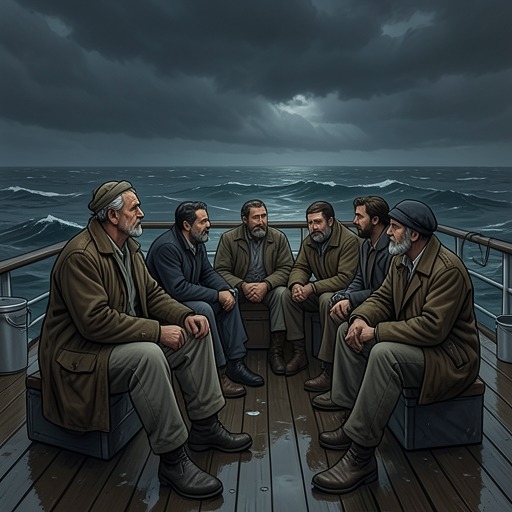
Starvation develops after the four fishermen lose access to ordinary food during the overturning of the boat. The accident itself follows a chain later identified by the Florida Fish and Wildlife Conservation Commission: the anchor line was improperly tied to an eye bracket on the port side of the transom, the throttle was used to pull the stuck anchor free, and insufficient slack allowed the stern to submerge and the boat to capsize. The men are consequently left in rough water with only what can be recovered from the overturned hull. The physical crisis is intensified by cold-water immersion, repeated exertion, seawater exposure, and the absence of a reliable distress signal or emergency position-indicating radio beacon.
The surrounding conditions make food deprivation especially dangerous. The Coast Guard recognizes that people thrown into the Gulf could swallow large quantities of seawater, producing a poisonous sodium imbalance, drawing water from cells, and progressing toward delirium, seizures, heart attack, and death from dehydration. Cold compounds that danger: hypothermia constricts blood vessels and diverts blood toward the body’s core, while shivering and strenuous movement consume energy. The men’s strength and fitness do not neutralize the problem. In fact, younger, more muscular bodies may have less insulating fat and require greater effort to remain afloat; an average twenty-five-year-old in water around sixty-five degrees would be expected to remain functional for 9.9 hours and survive for fifteen, shorter periods than the corresponding estimates for a fifty-year-old man.
Hunger as a Survival Timeline
Nick’s hunger becomes unmistakable after the first deaths. He describes a dry, constant stomach pain, “like a stomachache times twenty,” while thirst and cold press against the same dwindling reserve. His mind turns toward a specific meal from home: his mother’s eggs Benedict, made with four or five eggs on an English muffin, covered with Hollandaise sauce and lemon. The memory gives hunger a personal shape. Food is no longer merely fuel; it is an image of family, ordinary mornings, and a life that has become unreachable.
When Nick gets back onto the boat, he understands that drowning and exposure are no longer the only immediate ways to die. He believes that, if he does not survive, starvation or dehydration may kill him instead. That distinction marks a change in the emergency. The overturned hull offers limited physical refuge, but it does not restore the supplies or security of a functioning vessel. Nick can remain above water and still be losing the battle, because the body is spending energy simply to hold on.
The narrative makes deprivation visible through altered time. Without Will Bleakley beside him, there is no one with whom Nick can talk, and the second night expands unnaturally; what seems like an hour may be only twenty or twenty-five minutes. Hunger therefore affects both body and perception. It is joined to sleep deprivation, cold, and isolation, making the hours feel longer precisely as Nick has fewer physical resources with which to endure them.
Metabolic Breakdown and the Last Attempt
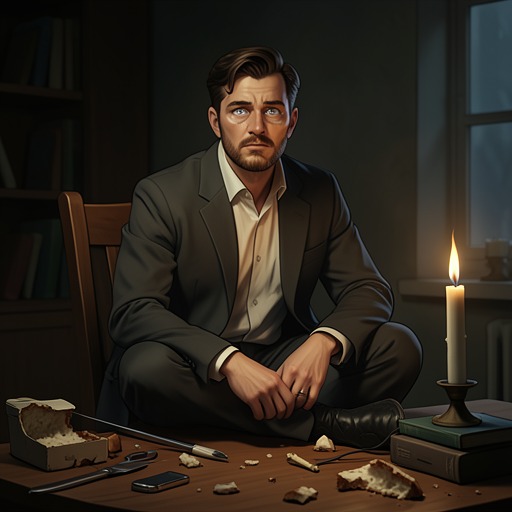
By the second day, Nick’s available food has been reduced to a few small pretzels and half a bottle of Gatorade. He had eaten pasta on Friday night and cereal and a protein bar on Saturday morning, but by Monday he feels empty. The chronology matters because the body’s deterioration is presented as cumulative rather than sudden: ordinary meals are followed by scattered remnants, then by the absence of food altogether.
Nick eventually recognizes that his body is no longer merely hungry. He feels that all his fat has been burned and that his body has begun consuming muscle. He sees thin legs, diminished muscular definition, pronounced ribs, and an abdomen with almost no remaining fat. His identity has been built around fitness, yet the survival process reverses that identity from within: the body that training made powerful becomes a reservoir being dismantled for energy. He understands the experience as a physical approach to death rather than as the familiar exaggeration of saying that a hard workout left someone “dead tired.”
The return of hunger becomes a command to act. Nick feels an urge to go beneath the boat in search of something to eat or drink, knowing that continued nutrient deprivation could damage his organs. He considers the danger of seawater and remembers a school lesson about desalinating salt water through evaporation and condensation, but he has no practical means of carrying out that method. The memory shows his mind still trying to convert knowledge into a survival tool even as delirium and weakness make action increasingly difficult.
Starvation, Hypothermia, and Behavior
Starvation cannot be separated from the men’s other physiological failures. Marquis Cooper begins to slur and ramble after swallowing salt water and gagging; he dry-heaves and shivers constantly. Corey Smith later develops similar signs, rambling and moaning before becoming intermittently unresponsive. After twelve hours in the water, Corey suddenly displays desperate, aggressive energy as he tries to climb onto the hull, repeatedly exerting himself for ten or fifteen seconds before going lifeless again. Nick understands that the cold has altered him and that the familiar, easygoing Corey is no longer governing his actions.
The medical account rejects the idea that Marquis, Corey, and Will simply chose to give up. Hypothermia can produce delirium, falling potassium levels, and the breakdown of heart-cell membranes until the heart can no longer contract. In this context, starvation is one pressure within a larger collapse involving cold, dehydration, salt exposure, and exhaustion. The men’s confused or forceful behavior is therefore not evidence of a moral failure or a lack of will. Their bodies and minds are being impaired by conditions that steadily remove their ability to make effective choices.
Nick’s rescue shows how close that process has brought him to death. After being recovered by the USCGC Tornado, his temperature is 89.5 degrees rather than the normal 98.6. He is cold, blue-lipped, clammy, and entering the early stages of shock, with painful legs and minor cuts worsened by salt water. He remains mostly coherent and knows his name, location, and the month, but cannot remember who is president. His survival is therefore not a clean triumph over hunger; it is a rescue of a body already severely depleted.
Narrative and Lasting Significance
Starvation gives the survival narrative its slowest and most intimate form of violence. The capsizing is instantaneous—the anchor holds, the stern submerges, and the boat rolls—but hunger unfolds afterward through repetition: stomach pain, thirst, shrinking strength, distorted time, and the recurring knowledge that every hour consumes another reserve. The contrast makes the sea’s danger legible not only as a dramatic accident but as a prolonged physiological process.
It also exposes the limits of athletic identity. The four men’s size and football strength help them pull, push, climb, and cooperate around the overturned boat, yet strength cannot make the hull right itself, cannot supply food, and cannot prevent cold from reaching the brain and heart. For Nick, starvation turns the discipline of training into a different kind of discipline: not performance or improvement, but the preservation of enough awareness to keep holding on and to attempt one final search for water or food.
After the rescue, the condition remains tied to Nick’s survivor’s guilt. Dr. Mark Rumbak argues that Nick has no reason to feel responsible for the deaths, because hypothermia and cardiac failure would have taken the others regardless of what he did. Yet Nick’s recollections continue to return to questions about what might have been changed—who wore which clothing, who received protection, and whether another choice could have prolonged someone’s life. Starvation thus survives in the narrative as more than a medical condition. It becomes the physical measure of how far the men were pushed, and a lasting reminder that survival depended not on will alone but on the alignment of weather, equipment, bodily reserves, and chance.